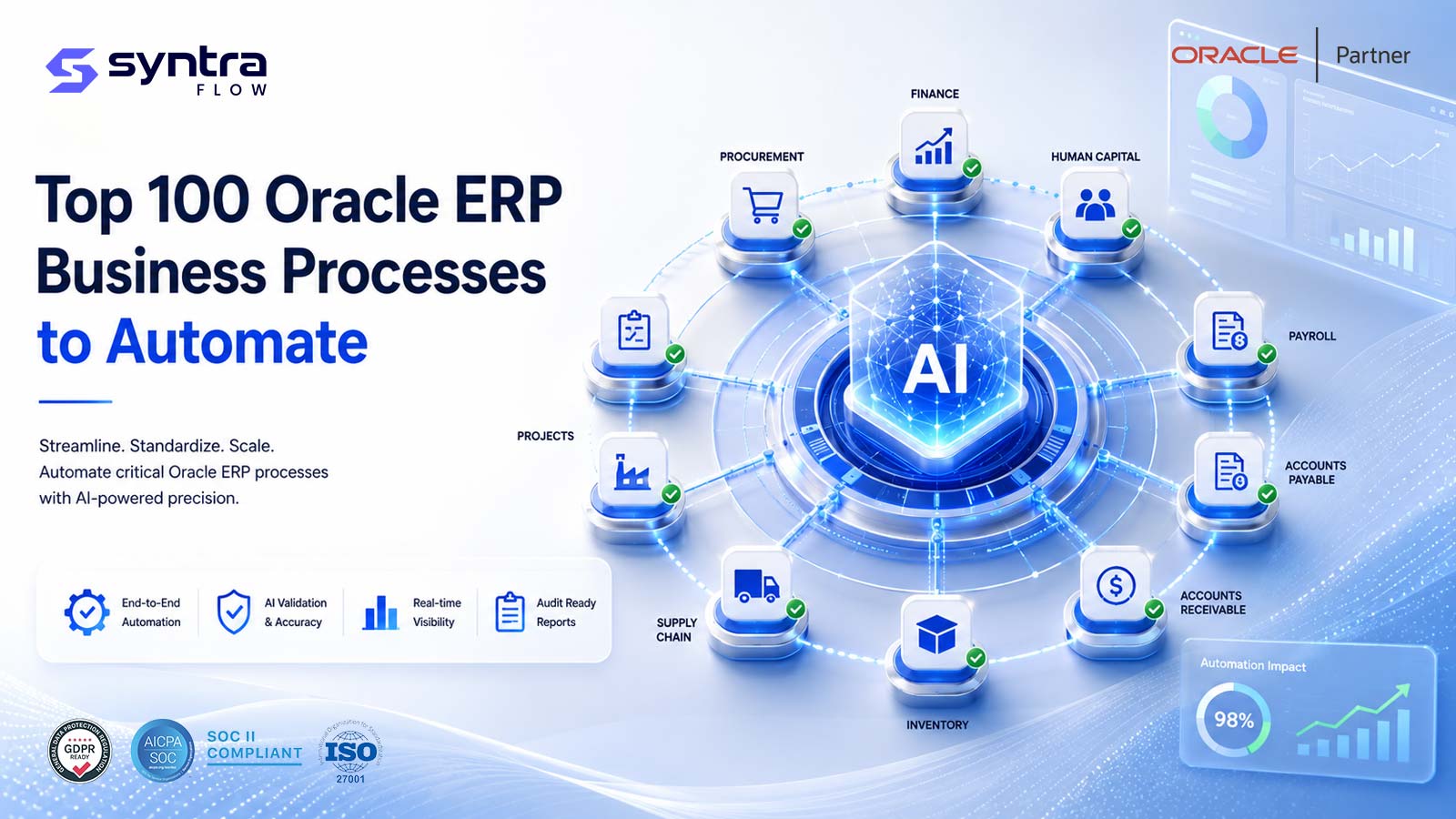
Oracle Fusion Cloud Applications receive roughly four quarterly updates a year, and every one of them can change how a configured process behaves without a single line of your own code changing. The processes you should regression-test before each update are the ones that (a) carry revenue, cash, payroll or statutory-compliance risk if they break, and (b) depend on the configuration and UI surfaces Oracle most often touches. This guide lists 100 of those processes, organised by end-to-end cycle — Procure-to-Pay, Order-to-Cash, Record-to-Report, Hire-to-Retire, Assets and Cash, Supply Chain and Manufacturing, and Projects — and gives you a risk-tier model to decide what to automate first. Every process below that has a dedicated Oracle ERP testing page is linked so you can drill into what to validate.
Last reviewed: 19 July 2026
In this guide
- Why automate before every quarterly update
- How to prioritise: a risk-tier model
- Procure-to-Pay (processes 1–18)
- Order-to-Cash (processes 19–40)
- Record-to-Report (processes 41–52)
- Hire-to-Retire (processes 53–72)
- Assets and Cash (processes 73–80)
- Supply Chain and Manufacturing (processes 81–92)
- Projects (processes 93–100)
- Priority-tier summary and downloadable checklist
Why automate before EVERY quarterly update
Oracle ships quarterly update families (labelled by year and letter, such as 26A, 26B, 26C, 26D) at a cadence of roughly four per year. Unlike on-premise upgrades that you scheduled at your own pace, these updates are applied to your test pods and then your production pod on a fixed calendar, and you cannot opt out indefinitely. Each update can introduce new features, change default behaviour, adjust the Redwood user experience, deprecate a page, or alter the way an existing setup is interpreted. Your configuration did not change — but the platform underneath it did.
The reason this matters so much for ERP specifically is that Oracle Fusion is overwhelmingly configuration-driven. Approval rules, tolerances, descriptive flexfields, tax rules, subledger accounting methods, pricing strategies, fast formulas and security roles all sit on top of the same code base Oracle updates. A change to a page's field behaviour, a new required attribute, a tightened validation, or a reworked Redwood flow can quietly break an approval chain, a match tolerance, or an integration mapping that your business depends on. Because the break is behavioural rather than a hard error, it often surfaces first as a stuck invoice, a mispriced order, or a payroll variance — not as an obvious defect in the release notes.
A concrete example makes the risk tangible. Suppose an update refines the behaviour of a Payables invoice-hold page so that a tolerance that previously released automatically now requires a manual acknowledgement. Nothing errors; the release notes describe it as an improvement. But the next pay run leaves a batch of invoices sitting on hold, your early-payment discounts lapse, and your AP team spends a week clearing a backlog nobody knew existed. A five-minute automated check of the hold-and-release path against the pre-production pod would have surfaced the changed behaviour before it reached live — which is precisely the kind of small, high-value test that belongs in a quarterly runbook.
This is why regression coverage has to run before each update reaches production, not after something goes wrong. A short, targeted regression pass on your highest-risk processes against the pre-production pod is the difference between catching a changed tolerance in a test environment and explaining a duplicate-payment or a failed pay-run to your controller. The typical Fusion update timeline gives you a window between the update landing on your test pod and its scheduled application to production; the goal is to use that window to run Tier 1 coverage and clear exceptions before the production date, not to discover surprises afterward. SyntraFlow can be configured to run this kind of targeted Oracle regression testing on a schedule aligned to the Oracle update calendar, and to focus effort using Release Intelligence so you test the areas an update actually touches rather than re-running everything blindly. For update-specific guidance, our quarterly patch testing guide goes deeper on the cadence.
There is now a second reason to keep this coverage current. Oracle has been shipping its own agentic AI into Fusion — AI Agent Studio reached general availability in release 25C, and the first Financials AI agents (Ledger, Payables, Payments and Expenses) plus the broader Fusion Agentic Applications wave reached general availability in 26B, with Oracle describing "more than 20" agentic applications across the suite. As these Oracle Financials AI agents begin to act on processes like invoice ingestion, matching and payment routing, the same business processes now have a new, probabilistic test surface. Confirm current agent availability and behaviour with Oracle for your release, and treat agent-assisted steps as processes that need their own validation.
How to prioritise: a risk-tier model
You cannot automate everything at once, and you should not try to. The practical way to decide what to build first is to score each process on two axes: impact if it breaks (revenue, cash, statutory or safety exposure) and likelihood of breaking on an update (how config-heavy, integration-heavy or UI-heavy it is). The processes that are high on both axes are your Tier 1 — automate and regression-run them every quarter, without exception. The model below is the tiering we recommend as a starting point; adjust the examples to your own footprint.
| Tier | What belongs here | Example processes | Test cadence |
|---|---|---|---|
| Tier 1 — Critical | Revenue-, cash- or compliance-critical; a failure means lost money, a missed pay run, or a regulatory breach. Usually high-volume and config-heavy. | Invoice matching & payment processing, sales-order-to-cash, payroll calculation, period close, tax calculation, revenue recognition. | Every quarterly update, plus any config change to the area. |
| Tier 2 — Important | Material to operations but with a manual fallback or lower blast radius. Config-dependent but lower volume, or upstream of a Tier 1 step. | Requisitions, receiving, shipping, collections, absence & time entry, fixed-asset additions, inventory transactions. | Every quarterly update where Release Intelligence flags the area; otherwise every second update. |
| Tier 3 — Standard | Lower financial exposure, more stable, or easily corrected after the fact. Still worth automating for coverage, but not update-blocking. | Catalog browsing, learning enrolments, project budget entry, performance check-ins, supplier qualification questionnaires. | Periodically, or when the specific module is updated. |
Two practical notes on using this model. First, end-to-end flows outrank single steps: a green result on "create sales order" and "run shipping" individually can still hide a break in the hand-off between them, so your Tier 1 set should include the stitched-together cycle, not only its parts. Second, let the update drive the emphasis. If Release Intelligence indicates a given update touches Payables and Tax, you lead with those Tier 1 areas that quarter rather than spreading effort evenly. The 100 processes that follow are tagged with a suggested tier so you can assemble your own first-pass automation backlog quickly.
A quick way to score a process
When you are unsure which tier a process belongs to, score it 1–3 on each of four questions and take the highest signal: (1) Money at risk — does a failure move cash, revenue or payroll, or trigger a regulatory breach? (2) Volume — does it run hundreds or thousands of times a period, so a small defect scales? (3) Config and integration density — how many rules, flexfields, tolerances and inbound/outbound integrations does it depend on? (4) Recovery difficulty — if it goes wrong, is the correction a quick re-run, or a painful unwind of posted accounting? Any process scoring high on money-at-risk plus either config density or recovery difficulty is a Tier 1 candidate regardless of volume. Processes that are stable, low-volume and easily corrected drop to Tier 3 even if they are functionally important. Re-score after a major footprint change — a new legal entity, a new integration, or a new statutory obligation can push a Tier 2 process up to Tier 1.
Procure-to-Pay (P2P) — processes 1–18
Procure-to-Pay is where configuration density is highest — approval hierarchies, match rules, tolerances, holds, payment terms and disbursement formats all live here, and all are sensitive to update changes. Validate the individual steps and then the stitched flow via the Procure-to-Pay testing tool.
- 1. Requisition creation and approval — Tier 2. Validate approval routing, account defaulting and requisition-to-PO conversion after each update. (Approval rules are a common update-sensitive surface.)
- 2. Self-service procurement — Tier 3. Shopping, non-catalog requests and requisition preferences in the Redwood experience.
- 3. Procurement catalog and punchout — Tier 3. Local catalog, punchout round-trips and smart-form behaviour.
- 4. Supplier onboarding and master data — Tier 2. Supplier sites, bank accounts and tax registrations that feed downstream payment and tax logic.
- 5. Supplier qualification and assessment — Tier 3. Qualification areas, questionnaires and initiative scoring.
- 6. Sourcing and negotiations — Tier 3. RFQs, auctions, response scoring and award-to-agreement conversion.
- 7. Purchase agreements — Tier 2. Blanket and contract purchase agreements, price breaks and release logic.
- 8. Purchase order creation and change orders — Tier 1. PO defaulting, approvals, change-order versioning and communication.
- 9. Receiving and inspection — Tier 2. Receipt routing, over/under-receipt tolerances and returns to supplier.
- 10. Invoice matching (2-, 3- and 4-way) — Tier 1. Match tolerances and quantity/price variance handling are frequently affected by config and by AI-assisted matching.
- 11. Invoice validation — Tier 1. Validation results, distribution accounting and tax calculation on the invoice.
- 12. Invoice holds and release — Tier 1. Automatic holds, manual holds and hold-release workflows that gate payment.
- 13. Prepayments and application — Tier 2. Prepayment creation, application against invoices and unapplication.
- 14. Payment terms and discounts — Tier 2. Term defaulting, due-date and discount-date calculation and instalment schedules.
- 15. Payment creation — Tier 1. Single and batch payment build, and validation against supplier bank details.
- 16. Payment processing and disbursement — Tier 1. Payment process requests, formats and settlement — a duplicate or malformed file here is a direct cash risk.
- 17. Payables period-end and AP close — Tier 1. Sweeping, unaccounted-transaction reports and transfer to the ledger. See the full Payables testing coverage.
- 18. End-to-end P2P flow — Tier 1. Requisition → PO → receipt → invoice → payment as one validated chain, not seven green checkmarks in isolation.
Order-to-Cash (O2C) — processes 19–40
Order-to-Cash carries direct revenue risk and spans Order Management, Shipping and Receivables. Pricing, holds, fulfilment orchestration and receipt application are all config-sensitive. Anchor your coverage on the Order Management testing tool and the Receivables testing tool.
- 19. Sales order capture — Tier 1. Order entry, defaulting and validation across manual and interfaced orders.
- 20. Order pricing and discounts — Tier 1. Price lists, pricing strategies, charges and discount application — a mispricing is immediate margin leakage.
- 21. Order holds — Tier 1. Credit, margin and manual holds that gate fulfilment and release logic.
- 22. Credit management — Tier 1. Credit checking at order entry, credit limits and case-folder review.
- 23. Order fulfilment orchestration — Tier 1. Orchestration-process steps, status flows and jeopardy handling.
- 24. Shipping and delivery — Tier 1. Pick release, ship confirm, documents and inventory relief.
- 25. Drop-ship orders — Tier 2. Supplier drop-ship flow, PO generation and receipt-driven billing.
- 26. Back-to-back orders — Tier 2. Supply-to-order reservation and back-to-back fulfilment linkage.
- 27. Return orders (RMA) — Tier 2. Return capture, receipt of returned goods and credit generation.
- 28. Billing and interface to AR — Tier 1. Fulfilment-to-billing hand-off and the interface into Receivables.
- 29. AutoInvoice import — Tier 1. Import validation, grouping rules and exception correction.
- 30. AR invoice creation — Tier 1. Manual and imported invoices, transaction types and distributions.
- 31. Revenue recognition — Tier 1. Revenue scheduling and contingencies — a compliance-critical area worth confirming against your accounting policy each update.
- 32. Receipt creation — Tier 1. Standard and miscellaneous receipts and receipt methods.
- 33. Receipt application — Tier 1. Application against invoices, on-account and unapplied balances.
- 34. Lockbox processing — Tier 2. Bank-file import, auto-application and post-batch review.
- 35. Credit memos and adjustments — Tier 2. Credit-memo application, adjustments and approval limits.
- 36. Collections and dunning — Tier 2. Strategies, dunning correspondence and promise-to-pay tracking.
- 37. Order Management configuration — Tier 1. Processing constraints, orchestration setup and status catalogs.
- 38. Receivables period close — Tier 1. AR reconciliation, unposted items and transfer to the ledger.
- 39. End-to-end O2C flow — Tier 1. Order → ship → bill → receipt → revenue validated as one continuous chain.
- 40. Available-to-promise and supply allocation — Tier 2. Global order promising and ATP checks at order entry. (No dedicated page; test alongside sales-order and inventory coverage.)
Record-to-Report (R2R) — processes 41–52
Record-to-Report is where every subledger lands, so an accounting or close defect here is both high-impact and hard to unwind. Subledger accounting rules, close orchestration and reporting are all update-sensitive. Ground your coverage in the General Ledger testing tool.
- 41. Journal entry creation and approval — Tier 1. Manual journals, spreadsheet upload, approval and posting.
- 42. Subledger accounting (SLA) — Tier 1. Accounting rules and the create-accounting process across subledgers — a single rule change ripples through the ledger.
- 43. Payables invoice accounting — Tier 1. Liability, accrual and tax accounting generated from AP invoices.
- 44. Receivables accounting — Tier 1. Revenue, receivable and receipt accounting from AR transactions.
- 45. Intercompany transactions — Tier 1. Intercompany balancing, transactions and reconciliation. (No dedicated page; test under the GL testing umbrella.)
- 46. Tax calculation and reporting — Tier 1. Tax rules, rates and reporting. For statutory frameworks (for example e-invoicing or VAT reporting regimes), confirm current thresholds and file specs with the relevant authority.
- 47. Bank reconciliation — Tier 1. Statement import, auto- and manual reconciliation and reconciliation accounting.
- 48. Period close and orchestration — Tier 1. Close status, allocations, revaluation and the sequence that produces the trial balance.
- 49. Financial reporting — Tier 1. Financial reports, OTBI analyses and Smart View retrievals against expected balances.
- 50. Ledger and chart-of-accounts setup — Tier 1. Ledger configuration, calendars, currencies and cross-validation rules.
- 51. End-to-end R2R flow — Tier 1. Subledger → create accounting → transfer → close → report as one validated chain.
- 52. Allocations, revaluation and translation — Tier 2. Recurring journals, currency revaluation and translation at close. (Test under period-close coverage.)
Hire-to-Retire (H2R) — processes 53–72
Hire-to-Retire runs on fast formulas, eligibility rules, security and payroll flows — and a payroll miss is one of the highest-visibility failures an ERP team can have. Frame this coverage with the HCM testing tool, and treat payroll as strictly Tier 1.
- 53. Worker and person records — Tier 2. Person creation, personal and legislative data that feed downstream processes.
- 54. Employment and hire — Tier 2. Hire, rehire and employment-terms flows across legal employers.
- 55. Assignment changes — Tier 2. Transfers, promotions and assignment attributes that drive pay and access.
- 56. Position management — Tier 2. Position hierarchies, defaulting and position-based security.
- 57. Recruiting (ORC) — Tier 3. Requisitions, candidate flows and offer-to-hire hand-off.
- 58. Learning — Tier 3. Course and offering enrolment, completions and compliance learning.
- 59. Performance management — Tier 3. Goal setting, performance documents and review workflows.
- 60. Compensation — Tier 1. Compensation plans, worksheets and allocations that flow into pay.
- 61. Benefits — Tier 1. Eligibility, life events and enrolment that generate payroll deductions.
- 62. Absence management — Tier 2. Accrual plans, absence entry and payroll integration.
- 63. Time and labor — Tier 2. Time-card entry, validation rules and transfer to payroll.
- 64. Payroll calculation — Tier 1. Gross-to-net, element entries and statutory deductions — the single highest-stakes process in HCM.
- 65. Payroll flow patterns — Tier 1. The end-to-end flow — calculate, verify, prepayments, payments and costing — run as a sequence.
- 66. HCM security and roles — Tier 1. Data-security policies, areas of responsibility and role changes that gate who sees and does what.
- 67. HCM configuration and flexfields — Tier 2. Enterprise structures, value sets and descriptive flexfields underpinning HCM.
- 68. Onboarding and offboarding journeys — Tier 3. Journey tasks and checklists on hire and termination. (Test under worker and employment coverage.)
- 69. Fast Formula validation — Tier 1. Payroll, absence and benefits fast formulas that update behaviour can affect indirectly. (Validate as part of payroll and absence flows.)
- 70. Payroll costing and GL transfer — Tier 1. Costing results and the transfer of labour cost to the ledger. (Test alongside payroll flow.)
- 71. Statutory and third-party payments — Tier 1. Social-insurance, wage-protection and gratuity-type obligations. Confirm current file specs and thresholds with the relevant authority; treat these as "what to test in Fusion," not legal advice.
- 72. HCM data loads (HDL / spreadsheet loaders) — Tier 2. Bulk loads whose templates and validations can shift on updates. (Validate against target data models each release.)
Assets and Cash — processes 73–80
Fixed Assets and Cash Management are lower-volume but high-value: depreciation runs and payment settlement both move real money and both feed the ledger. Cover them with the Fixed Assets testing tool and the Cash Management testing tool.
- 73. Fixed-asset additions and master data — Tier 2. Manual additions, mass additions from Payables and asset categories.
- 74. Asset lifecycle — Tier 2. Transfers, retirements, reinstatements and adjustments across the asset book.
- 75. Depreciation run — Tier 1. Depreciation calculation, close and the journal to the ledger.
- 76. Cash management and bank statements — Tier 1. Bank-statement processing, reconciliation and cash accounting.
- 77. Asset capitalization from CIP and projects — Tier 2. Construction-in-process capitalization into Fixed Assets. (Test with asset-lifecycle and Projects.)
- 78. Bank account and signatory setup — Tier 2. Bank, branch and account configuration feeding payments and reconciliation.
- 79. Cash positioning and forecasting — Tier 3. Cash position and forecast reporting against expected balances.
- 80. Asset physical inventory and impairment — Tier 3. Physical-inventory reconciliation and impairment adjustments.
Supply Chain and Manufacturing — processes 81–92
Inventory accuracy and cost-to-ledger integrity underpin both the balance sheet and O2C fulfilment, and manufacturing execution adds work-order and costing complexity. Cover the domain with the SCM testing tool and Inventory testing tool.
- 81. Inventory on-hand and item master — Tier 1. On-hand accuracy, item setup and organization parameters.
- 82. Inventory transactions — Tier 1. Receipts, issues, transfers and adjustments — the events that drive both stock and cost.
- 83. Inventory-to-GL and cost accounting — Tier 1. Cost processing and the transfer of inventory value to the ledger.
- 84. Manufacturing execution — Tier 2. Work-order creation, operation execution, completions and resource transactions.
- 85. Supply chain orchestration — Tier 2. Cross-module SCM orchestration and supply-chain financial orchestration flows.
- 86. Cycle counting and physical inventory — Tier 2. Count generation, approval and adjustment posting.
- 87. Cost accounting close — Tier 1. Periodic cost processing and cost-accounting close; Oracle also offers agentic support in this area — confirm availability for your release.
- 88. Min-max and replenishment planning — Tier 3. Replenishment requests and reorder logic.
- 89. Inter-org and intercompany transfers — Tier 2. Transfer orders and internal material shipments.
- 90. Warehouse receiving and shipping — Tier 2. Inbound and outbound warehouse execution feeding inventory.
- 91. Work definition and BOM changes — Tier 3. Bill-of-material and work-definition maintenance.
- 92. Supply planning and ATP — Tier 2. Supply plans and available-to-promise feeding order promising.
Projects — processes 93–100
Project Portfolio Management bridges operations and finance — costing, billing and capitalization all post to the ledger, so accuracy here is a Tier 1/2 concern for project-driven organisations. Cover it with the Projects testing tool.
- 93. Project and task structure — Tier 2. Project creation, task hierarchies and project-type defaulting.
- 94. Project costing and expenditure import — Tier 1. Cost import from Payables, timecards and expenses, and cost distribution.
- 95. Project billing and invoicing — Tier 1. Billing methods, invoice generation and transfer to Receivables.
- 96. Project budgets and forecasts — Tier 2. Budget and forecast versions and baseline control.
- 97. Capital projects and CIP capitalization — Tier 2. CIP accumulation and capitalization into Fixed Assets.
- 98. Project contracts and revenue — Tier 1. Contract-based revenue recognition and billing controls.
- 99. Resource management and assignments — Tier 3. Resource requests, assignments and utilisation.
- 100. Project accounting to GL — Tier 1. Project subledger accounting and transfer to the ledger.
Where Oracle's own AI changes the test surface
Several of the 100 processes above are exactly where Oracle is deploying agentic AI. The four Financials AI agents (Ledger, Payables, Payments and Expenses) reached general availability in 26B, and Document IO gen-AI invoice ingestion became a default in Payables in the same release; MCP tools, external REST tools, REST-API agent access and Slack and Microsoft Teams channels arrived in 26A, and Agent2Agent (A2A) in 26C. What this means for your test plan is that a process like invoice matching or payment routing may no longer be purely deterministic — an agent can now suggest or take a step, and the "correct" outcome becomes a range rather than a single value.
That calls for a different validation style: instead of asserting one expected result, you define an acceptable outcome envelope (auto-approve, escalate, or reject) and check that the agent's decision falls inside your policy boundary. Two additional habits help. First, keep testing the deterministic path underneath the agent — the configuration, tolerances and accounting rules do not disappear when an agent sits on top, and they still change on updates. Second, treat the agent as something whose behaviour can drift over time, so a suite that validated it this quarter is worth re-running next quarter even if the agent's configuration looks unchanged. Oracle also describes agentic support in other domains by function or workspace — for example Design-to-Source and a Sourcing Command Center in supply chain, and a Cost Accounting Close capability — rather than as singular branded "X Agent" products; attribute these to Oracle's own announcements and confirm scope for your release.
SyntraFlow can be configured to test both the classic configuration behaviour and the agent-assisted behaviour of these processes; see our overview of Oracle agentic applications and the Financials AI agents for how the new surface maps onto the process list. Because agent capabilities move release to release, confirm current availability and behaviour with Oracle before relying on any specific agent in production.
Priority-tier summary
Use the summary below to assemble a first-pass automation backlog. It maps each end-to-end cycle to the processes that most teams should treat as Tier 1 — run every quarter — versus those that can move to a lighter cadence. Adjust to your own volumes, integrations and regulatory footprint.
| Cycle | Tier 1 — every update | Tier 2/3 — lighter cadence | Primary hub page |
|---|---|---|---|
| Procure-to-Pay | Matching, validation, holds, payments, payment processing, AP close, end-to-end P2P | Requisitions, catalog, sourcing, supplier qualification, receiving | P2P testing |
| Order-to-Cash | Sales order, pricing, holds, fulfilment, shipping, billing, AutoInvoice, revenue, receipts, end-to-end O2C | Drop-ship, back-to-back, returns, lockbox, credit memos, collections | Order Management |
| Record-to-Report | Journals, SLA, invoice/receivables accounting, tax, bank recon, period close, reporting, end-to-end R2R | Allocations, revaluation and translation | GL testing |
| Hire-to-Retire | Payroll, payroll flow, HCM security, compensation, benefits, statutory payments | Worker, employment, assignment, position, time, absence, recruiting, learning, performance | HCM testing |
| Assets & Cash | Depreciation run, cash management and reconciliation | Asset additions, lifecycle, positioning, physical inventory | Fixed Assets |
| SCM & Manufacturing | Inventory on-hand, inventory transactions, inventory-to-GL, cost accounting close | Manufacturing, cycle counting, transfers, planning, BOM changes | SCM testing |
| Projects | Project costing, billing, contract revenue, project accounting to GL | Task structure, budgets, capital projects, resource management | Projects testing |
Get the Top 100 process automation checklist
Top 100 Oracle ERP Process Automation Checklist
We maintain a working version of this list as a checklist — all 100 processes, each with a suggested risk tier, the update surfaces most likely to be affected, and a column to record your last regression date. It is designed to be dropped straight into your quarterly-update runbook. It is available on request rather than as a public download; a SyntraFlow specialist will walk you through applying the tiers to your footprint and mapping the linked process pages to your test suite.
Request the Top 100 checklist and a walkthrough →How SyntraFlow helps
SyntraFlow can be configured to build and maintain automated coverage across the processes above, run targeted regression before each Oracle quarterly update, and connect that testing to release intelligence so you concentrate effort on what an update actually changes. It helps organizations assess which processes carry the most update risk, and can validate both classic configuration behaviour and the newer agent-assisted steps as Oracle's AI expands. SyntraFlow does not guarantee coverage of every process or replace your own risk judgement — it gives your team a faster, more focused way to protect the cycles that matter most, quarter after quarter. To turn this list into live coverage, build your Oracle process automation coverage with SyntraFlow and start with your Tier 1 cycles.
Official Oracle references
- Oracle Fusion Applications AI
- Oracle Fusion AI key capabilities
- Oracle Financials AI agents (26B documentation)
- Oracle Readiness / What's New